
Integration · Jira Cloud
Send retrospective action items to Jira
Free for one team · Jira is included on every plan
Try it: an action item from a retro
Give staging an owner and an alert
Press the button. In Retro Rabbit, the action item gets this chip with the issue and its status, and the chip opens the issue in Jira.
What the Jira integration does
From action item to Jira issue
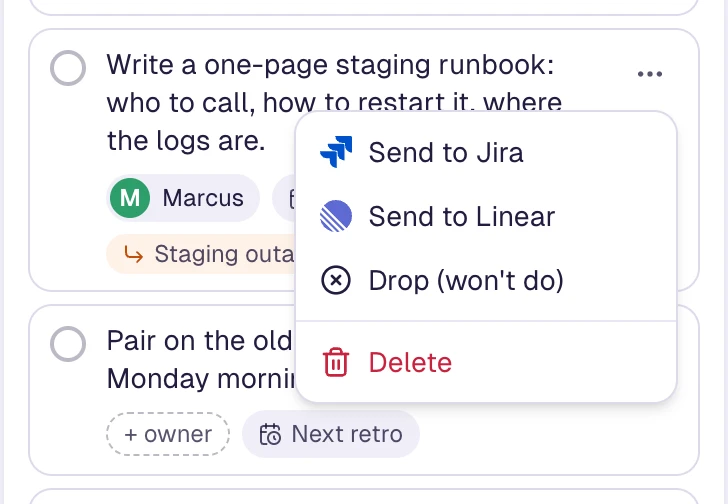
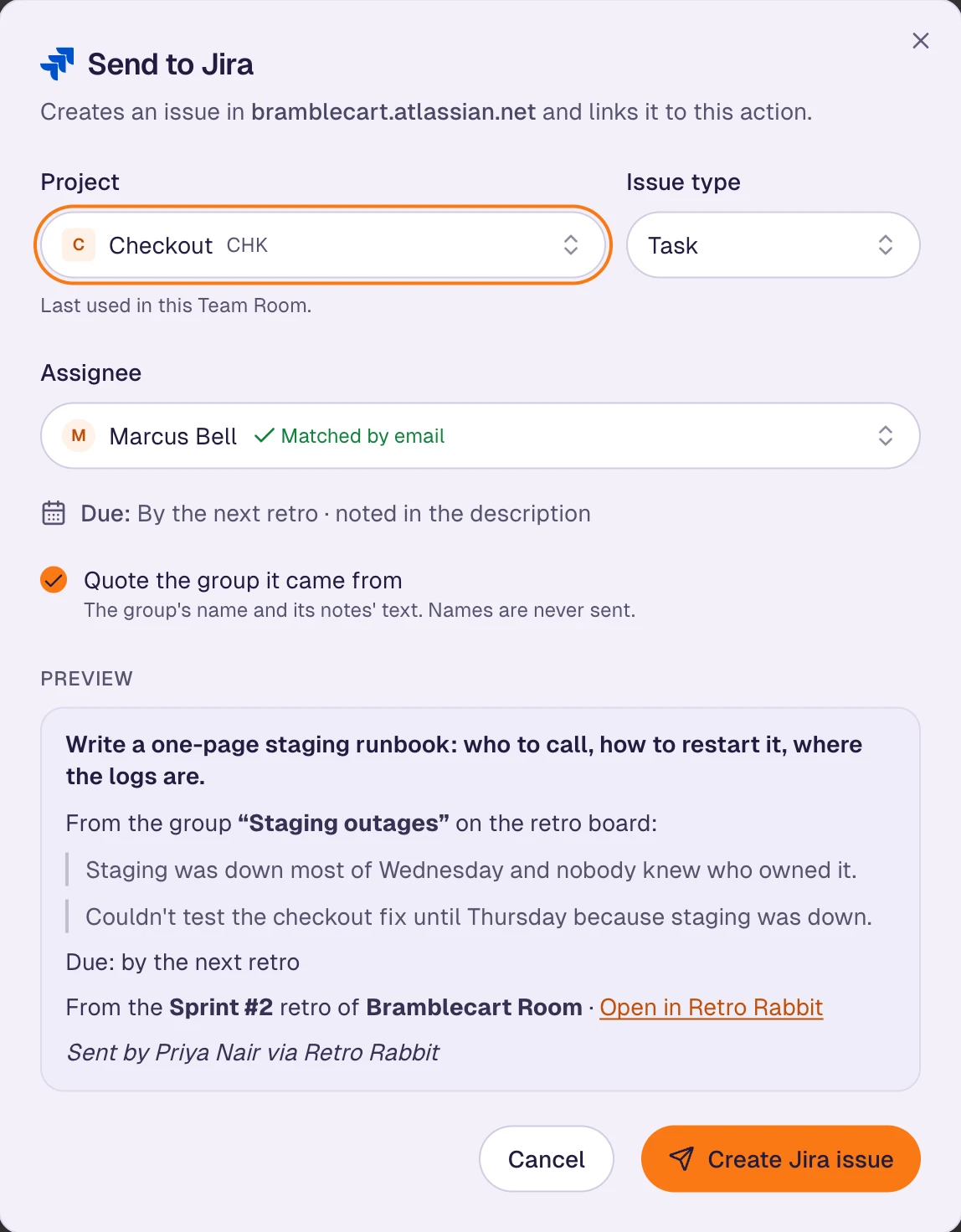
Open an action item’s menu and choose Send to Jira. Pick the project, issue type and assignee, check the preview, and create the issue.
The issue shows on the action
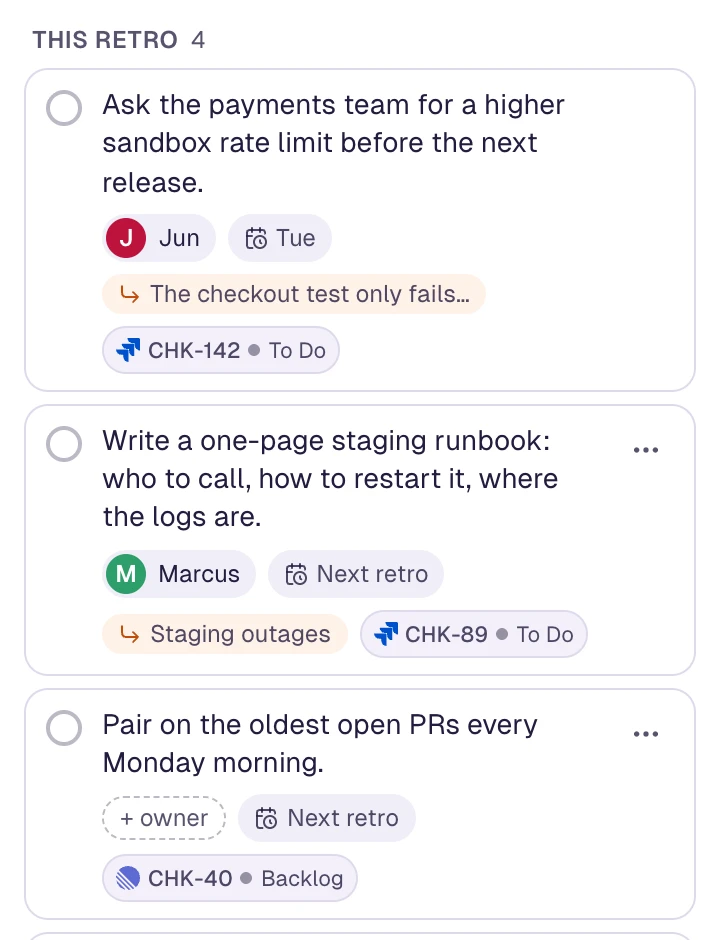
The action item gets a chip such as ENG-142 · To Do. It opens the issue in Jira, and its status is re-read when someone opens the board.
The issue links back to the retro
The Jira issue carries a link to the retro it came from and can quote the note that led to it. Names of note authors are never sent.
How to connect Jira
- 1
Sign in to Retro Rabbit as an organization admin
Only admins can connect or disconnect Jira. Members see who connected it, or who to ask.
- 2
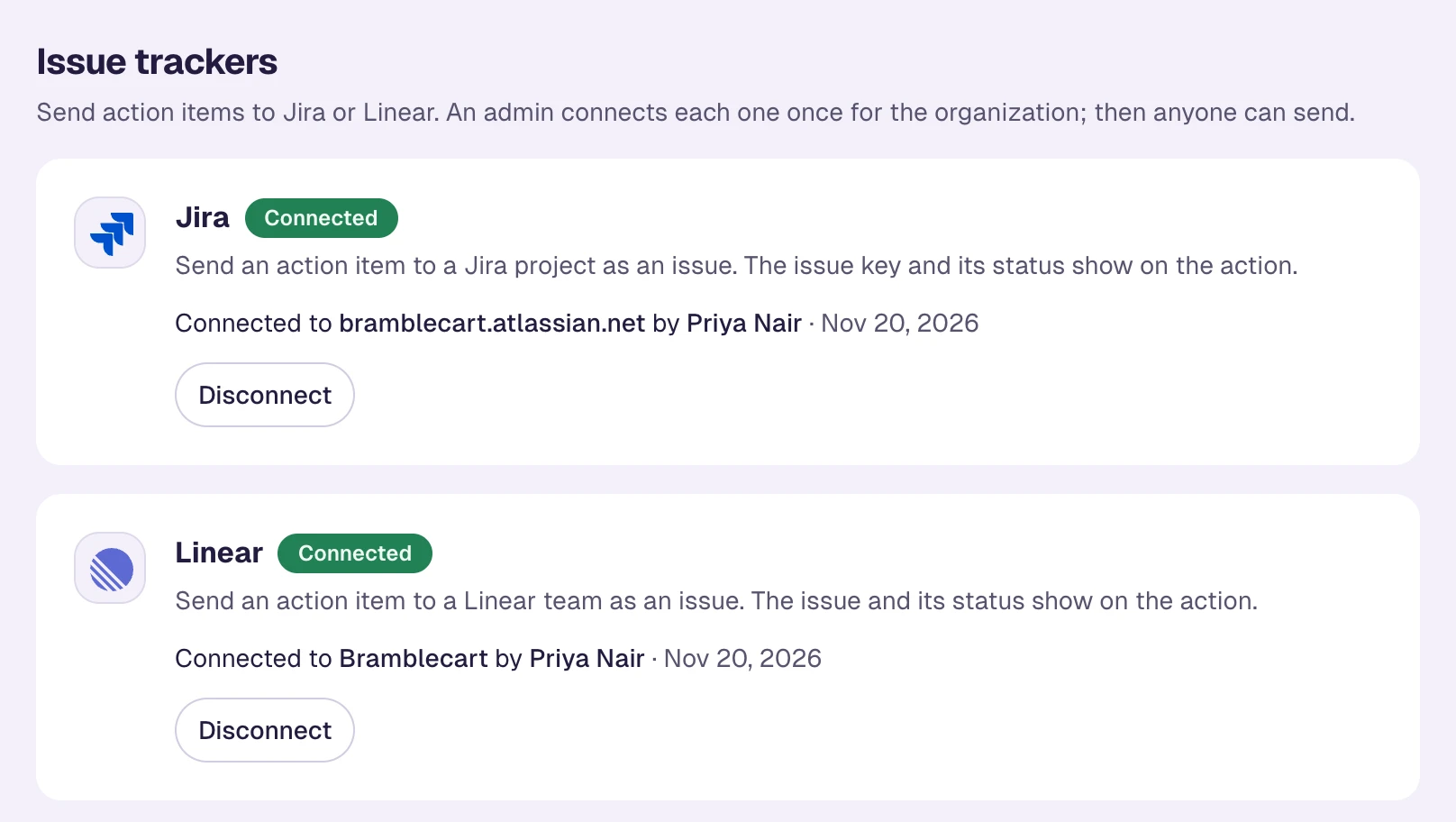
Open Integrations and press Connect Jira
Integrations is in the dashboard sidebar. Jira is listed under Issue trackers.
- 3
Approve the access on Atlassian’s screen
Atlassian shows what Retro Rabbit is asking for and which Jira site it applies to. Approve it and you land back on the Integrations page.
- 4
Choose a site, if you have more than one
If your Atlassian account has several Jira sites, pick the one Retro Rabbit should send to. An organization sends to one Jira site.
- 5
Send your first action item
On a retro board or in My actions, open an action item’s menu and choose Send to Jira. From now on, any member of the organization can do the same.
What shows back in Retro Rabbit
- An issue chip
- The issue key and its current status, for example ENG-142 · In Progress, with a dot for to do, in progress, done or canceled.
- Wherever the action is
- On the retro board, in My actions, and in the check-in at the start of the next retro. Everyone on the board sees the chip as soon as the issue is created.
- A link to the issue
- Click the chip, or choose Open in Jira from the action’s menu, to go straight to the issue.
- A current status
- Retro Rabbit re-reads the status from Jira when someone opens the board or the action list, at most once every 10 minutes for each issue.
What lands in Jira
- Summary
- The action item’s text (up to 255 characters; a longer one is repeated in full in the description).
- Description
- The note or group the action came from, quoted, unless you untick it. Then a line naming the retro with a link back to it, and who sent it.
- Due date
- A specific due date goes into Jira’s due date field when the project has one, and into the description when it doesn’t. “By the next retro” is noted in the description.
- Assignee
- Retro Rabbit suggests the action item’s owner by matching their email in Jira. You can pick someone else or leave it unassigned.
- Reporter
- The Atlassian user who connected Jira. The description says which teammate sent it.
- Web link
- A link on the issue back to the retro in Retro Rabbit.
Limits, stated plainly
Jira Cloud only. Jira Data Center and Jira Server aren’t supported.
It’s one-way. Retro Rabbit creates the issue and reads its status. Edits made in Jira don’t come back, and editing the action item later doesn’t change the issue.
Statuses aren’t instant. They refresh when someone opens the board or the action list, at most once every 10 minutes per issue.
Nothing is sent automatically. A person sends each action item, and each action item becomes one issue, once.
One Jira site per organization. Any project on that site can be chosen each time you send.
Some issue types can’t be used. If an issue type requires a field Retro Rabbit can’t fill, it’s marked “needs fields”. Choose another type, such as Task.
No data comes in from Jira. Retro Rabbit doesn’t import sprints, issues or reports, and it doesn’t connect to Confluence.
Guests can’t send. People who joined a retro with just their name see issue chips but need an account to send an action item.
Frequently asked questions
Does Retro Rabbit work with Jira?
Yes, with Jira Cloud. An organization admin connects Jira once, and then any member can send a retrospective action item to a Jira project as an issue. The issue key and its status show on the action item in Retro Rabbit.
Is the Jira integration free?
Yes. Jira is included on every plan, including the free plan for one team. See pricing.
Who can connect Jira, and who can send action items?
Only an organization admin can connect or disconnect Jira. Once it’s connected, any member can send action items. People who joined a retro as a guest, with just their name, can’t send.
Does it work with Jira Data Center or Jira Server?
No. The integration is for Jira Cloud only.
Is it a two-way sync?
No. Retro Rabbit creates the Jira issue and shows its key and status on the action item. The status is re-read when someone opens the board, at most once every 10 minutes per issue. Other changes made in Jira don’t come back, and completing the action item in Retro Rabbit doesn’t close the issue.
What does Retro Rabbit send to Jira?
The action item’s text, its due date, the assignee you choose, a link back to the retro and, if you leave the box ticked, the text of the note or group it came from. Names of note authors are never sent. The Send dialog shows a preview of the exact issue first.
What access does Retro Rabbit ask for?
It connects through Atlassian’s own OAuth screen and asks to read and create Jira issues, read users (so an assignee can be chosen) and manage webhooks. It registers no webhooks today. The access tokens are stored encrypted (AES-256-GCM).
How do we disconnect Jira?
An admin presses Disconnect on the Integrations page. Issues already sent stay in Jira and their links stay on the action items, but their statuses stop refreshing. To remove Retro Rabbit on the Atlassian side as well, remove it from the connected apps in your Atlassian account.
More integrations
All integrations- LinearSend a retro action item to a Linear team as an issue. The issue and its status show back on the action.How it works
- SlackAdd a retro note without leaving Slack with /retro, and get reminders to add notes where your team already talks.How it works
- MCP serverLet an AI tool list your retros, read notes, and add notes and action items as you, over the Model Context Protocol.How it works
Run the retro. Send the actions to Jira.
Start with one team for free, connect Jira from the Integrations page, and your next action items land where the work is tracked.
Free for one team · No credit card